From Coders to Builders
In the early days of software, engineers were often seen as coders—people who translated requirements into lines of code. But the future of software development is shifting. Software engineers are evolving into builders, shaping not just applications but entire ecosystems, workflows, and digital infrastructures.
Why the Builder Mindset Matters
- Complexity of Modern Systems: Cloud-native architectures, AI-driven workflows, and distributed systems demand holistic thinking.
- Integration of Disciplines: Future builders will blend coding with product design, data analysis, and even storytelling.
- Ownership and Impact: Builders take responsibility for the entire lifecycle of software, aligning engineering with business outcomes.
Solvers vs. Builders
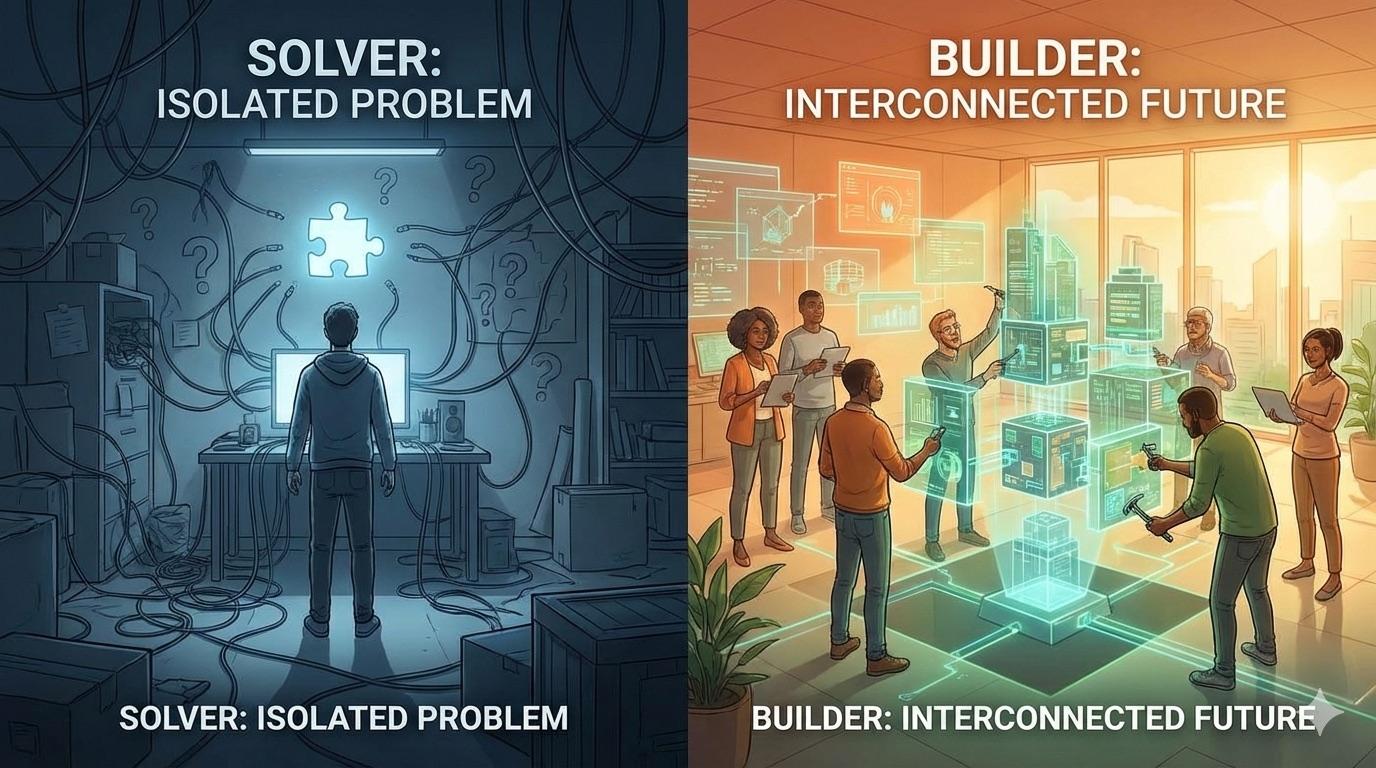
While problem-solving is a core skill, the future demands more than just being a solver. Solvers fix immediate issues, but builders create systems that anticipate challenges and empower others to solve problems at scale.
Limitations of the Solver Mindset
- Reactive, not proactive: Solvers wait for problems to appear before acting, limiting innovation.
- Short-term focus: Solutions may work today but fail tomorrow when systems grow or evolve.
- Individual contribution only: Solvers often work in isolation, focusing narrowly on tasks rather than shaping collective outcomes.
Why Builders Are Essential
- Vision and Architecture: Builders design with foresight, ensuring systems can evolve with technology shifts like AI, edge computing, and quantum.
- Empowerment: Builders create platforms, tools, and processes that allow teams and communities to thrive.
- Sustainability: Builders embed resilience, security, and adaptability into their creations.
- Cultural Leadership: Builders foster collaboration, mentor others, and shape organizational culture.
Industry Signals: OpenClaw Joining OpenAI
Recent industry moves—such as OpenClaw joining OpenAI—illustrate how AI capabilities and developer tooling are consolidating into platform ecosystems. For builders, this consolidation matters because it:
- Expands access to advanced models and tooling: Builders can leverage integrated stacks to prototype and scale faster.
- Raises the bar for architecture: With powerful AI primitives available, builders must design systems that responsibly incorporate these capabilities.
- Shifts competitive advantage: Organizations that cultivate builder cultures will extract more value from platform-level integrations than those that rely solely on ad-hoc problem-solving.
In short, platform consolidation accelerates the need for engineers who can architect systems, govern AI responsibly, and build extensible foundations rather than one-off fixes.
The Tools That Empower Builders
- Low-code and no-code platforms free engineers from repetitive tasks.
- AI-assisted development accelerates coding but requires human builders to guide architecture and ethics.
- Cloud ecosystems enable solutions that scale instantly.
The Human Side of Building
Being a builder is not just technical—it’s cultural. Builders foster collaboration, mentor teams, and create environments where innovation thrives. They are the bridge between vision and execution, ensuring that technology serves people, not the other way around.
Looking Ahead
In the future, software engineers will be recognized less for the code they write and more for the systems they build. They will be the architects of digital society, shaping tools that empower communities, businesses, and individuals.
The builder mindset transforms software engineering into a craft of creation, responsibility, and vision. And in that future, every engineer is not just a coder—they are a builder of worlds.