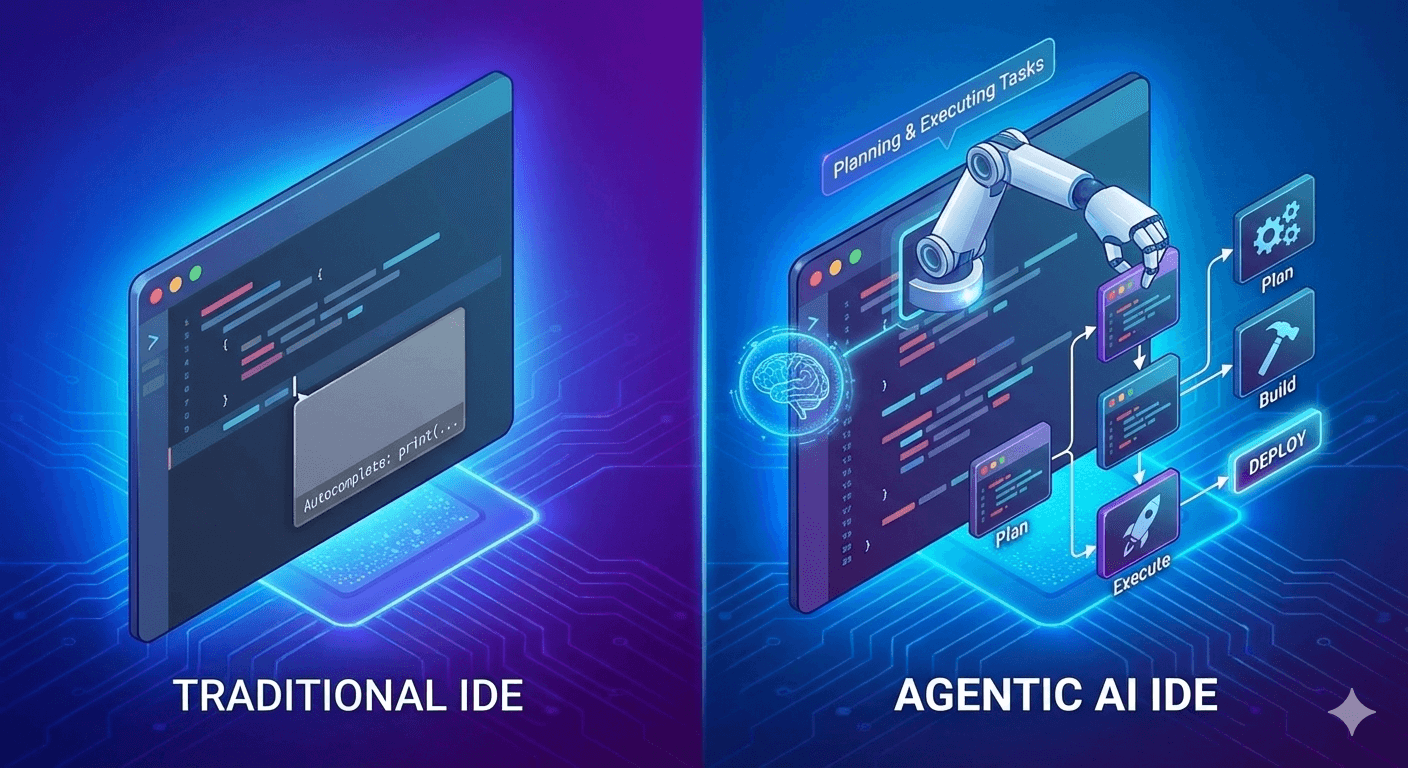
Autocomplete is no longer the headline feature. The bigger shift is that AI inside the IDE is becoming agentic: it can take a goal, break it into steps, use tools (search, edit, build, test), and loop until the job is done.
VS Code has been publishing work around AI editing and agent workflows (including “open source AI editor” milestones), and the direction is clear: more plan/execute, less “here’s a snippet, good luck wiring the rest”.
Autocomplete vs agentic workflows
Autocomplete is “predict the next tokens.”
Agentic is closer to a teammate:
- Understand the goal and constraints.
- Produce a short plan.
- Make coordinated changes across the repo.
- Run checks (
lint,typecheck,test,build). - Fix what breaks, then re-run checks.
- Summarize what changed and what to verify.
This matters most in real apps where “the code” is only part of the work: configs, runtime boundaries, build pipelines, migrations, and deployment details are where time is usually lost.
The plan/execute features you’ll see more of
- Multi-file refactors: consistent changes across components, routes, tooling, and config.
- Tool use: running commands, reading error output, iterating until green.
- Context retrieval: targeted search through the repo instead of guessing.
- Guardrails: approvals for network access, destructive operations, and secrets handling.
If you’ve ever asked an AI to “upgrade Next.js” and then spent hours fixing ESLint/TS/CSP/SSR issues, agentic workflows are designed to close that gap.
How to make agentic IDEs succeed (practical playbook)
1) Give acceptance criteria, not just tasks
Better prompt:
- “Replace X with Y, keep UI identical,
pnpm buildpasses, and Netlify deploy works.”
Worse prompt:
- “Refactor this to be modern.”
2) Keep your scripts clean and predictable
Agentic flows love deterministic “green bar” commands:
pnpm lintpnpm typecheckpnpm test(if you have it)pnpm build
If you add a new workflow, wire it into a script so the agent can run it consistently.
3) Reduce your tool surface area
Counterintuitive but real: agents become more reliable with fewer tools and clearer conventions. Prefer standard commands over one-off scripts unless the script is essential and documented.
4) Document “how this repo works”
Short contributor docs (like AGENTS.md) improve outcomes because the agent doesn’t need to guess:
- where modules live
- how routing is structured
- what the deployment target is
- which env vars are required
- how data flows (DB/auth/caching)
5) Treat it like pair programming
Agentic changes are fast, but you still want human review for:
- security-sensitive diffs (auth, CSP, redirects)
- DB migrations
- dependency upgrades
- anything that touches secrets or external APIs
A prompt template that works well
Use this as a starting point:
Goal: …
Constraints: Next.js App Router, TypeScript, Tailwind, PNPM. No breaking URL changes. Keep existing design tokens and UI patterns.
Done means:pnpm lint,pnpm typecheck,pnpm buildpass locally; no new console warnings; deploy config unchanged (or documented).
Please: propose a short plan, then implement. If you need to make tradeoffs, list them.