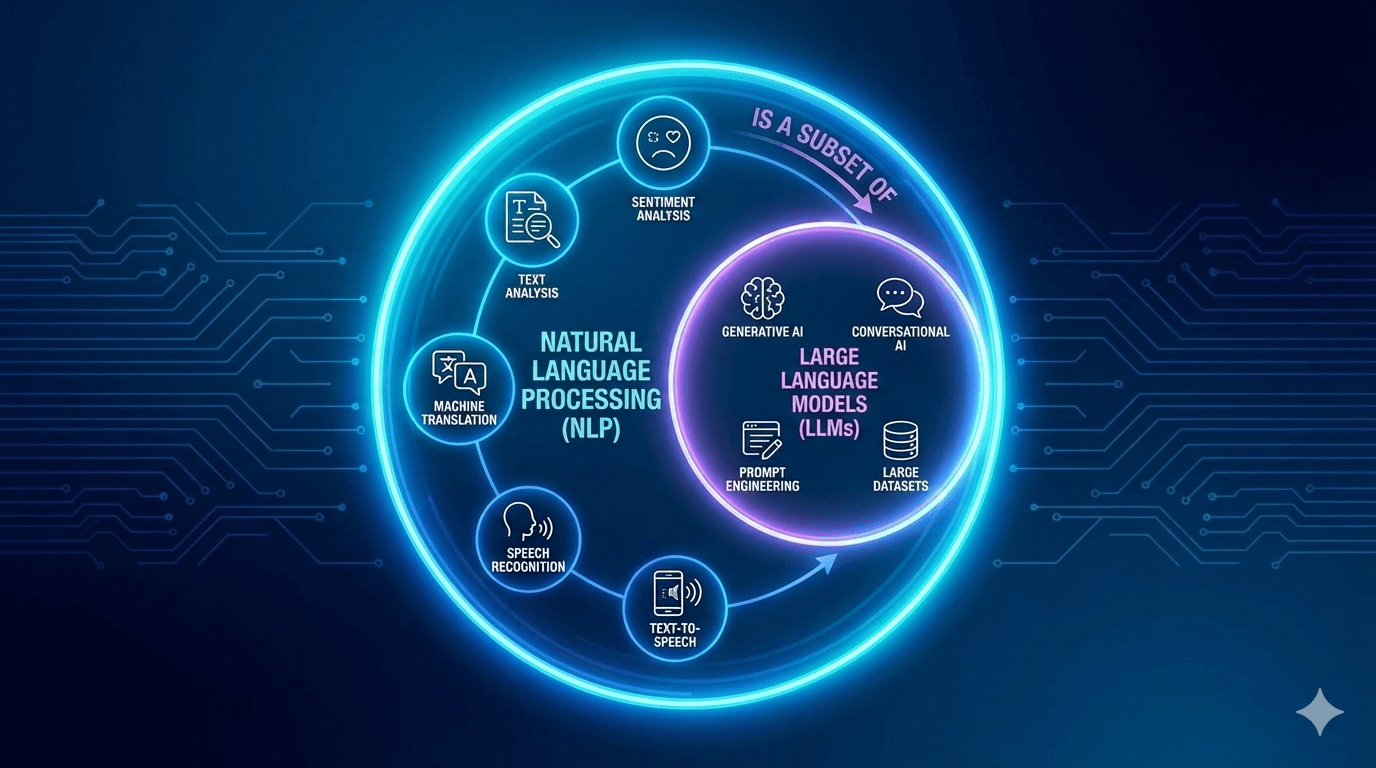
Yes—LLMs are strongly correlated with NLP because they are currently the most popular way to solve many NLP problems. But the relationship is simple:
- NLP (Natural Language Processing) is the field: understanding and generating human language.
- LLMs (Large Language Models) are one powerful approach within that field.
Think of NLP as “web development,” and LLMs as “React.” Highly related, often used together, but not the whole story.
What NLP covers (beyond chat)
NLP includes tasks like:
- text classification (spam, sentiment, intent)
- information extraction (entities, relations, structured fields)
- search and retrieval (ranking, query understanding)
- summarization, translation, rewriting
- question answering (with or without retrieval)
- speech-related pipelines (often paired with ASR/TTS)
It also includes foundational topics that LLMs don’t replace:
- evaluation methodology (precision/recall, robustness, bias)
- dataset curation and labeling
- multilingual processing
- privacy, safety, and security constraints
- product UX for language features (not just model quality)
Where LLMs fit inside NLP
LLMs are modern neural models (usually Transformers) trained on large corpora with objectives like next-token prediction. That training produces a general-purpose model that can be adapted to many NLP tasks using:
- prompting (zero-shot / few-shot)
- tool use (function calling)
- RAG (retrieval-augmented generation)
- fine-tuning (specialized behavior or style)
In practice, LLMs often reduce the need to build many task-specific models—but they don’t eliminate the need for good NLP system design.
Classic NLP vs. LLM-based NLP (when each wins)
Classic NLP often wins when you need:
- predictable behavior and tight control
- low latency and low cost
- offline / edge environments
- clear metrics and stable outputs
Examples:
- regex + rules for formatting/validation
- keyword + BM25 search
- small classifiers for spam detection
- deterministic extraction pipelines
LLM-based NLP wins when you need:
- flexible language understanding across many variations
- multi-step reasoning with context
- generating helpful natural-language outputs
- rapid iteration without retraining for every new rule
Examples:
- summarizing long notes into structured bullets
- extracting fields from messy user text (with schema validation)
- rewriting copy for different audiences/tone
The key takeaway: NLP is a system, not a model
Shipping NLP features usually means combining multiple parts:
- retrieval (search or vector embeddings)
- grounding (sources, citations, tool outputs)
- validation (schemas, constraints, policy filters)
- UX (preview, confidence cues, undo, safe defaults)
- monitoring (quality regressions, cost, latency, abuse)
Even if an LLM does the “language part,” the rest is still classic NLP/product engineering.
Practical advice (if you’re building with LLMs)
- Treat LLM output as untrusted until validated.
- Use RAG or tools for facts instead of “hoping it knows.”
- Add structured outputs (JSON schema) where possible.
- Measure success using NLP-style evaluation: accuracy/coverage, error categories, and regression tests.
LLMs are currently the center of attention in NLP—but learning NLP concepts will make your LLM features more reliable, cheaper, and easier to improve.