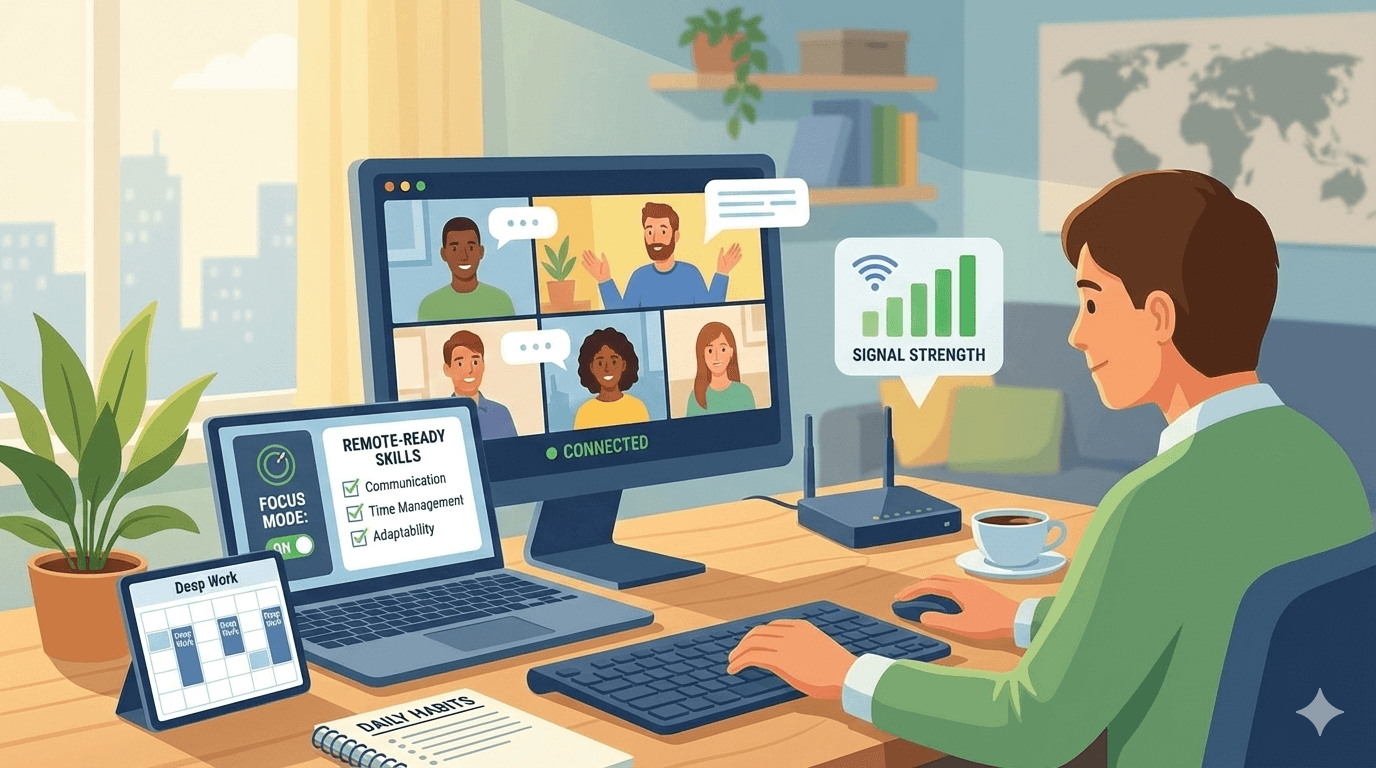
“Remote-ready” isn’t a job title. It’s a set of behaviors that reduce uncertainty for your team. The best remote engineers make progress visible, decisions traceable, and delivery predictable—without requiring everyone to be online at the same time.
What “remote-ready” really means
Remote work removes hallway context. So remote-ready engineers compensate with clarity:
- Clear intent: you explain why a change exists, not just what changed.
- Async-first execution: you unblock others without scheduling meetings.
- Operational empathy: you think about deploys, rollbacks, monitoring, and on-call impact.
- Consistent delivery: small, reviewable increments that ship.
Signals hiring teams look for (and how to show them)
1) Written communication that scales
Strong signals:
- PR descriptions that include goal, approach, trade-offs, and how to verify.
- Short design notes for non-trivial changes (even a
docs/markdown is enough). - Issues with crisp reproduction steps and acceptance criteria.
Example PR template:
- Context: why this matters
- Changes: what you did (high level)
- Risks: what could break + mitigations
- Verification: commands + screenshots (if UI)
2) Async collaboration
Remote-ready engineers reduce feedback latency:
- Use small PRs where possible.
- Leave “reviewer maps” (what files matter most, what to focus on).
- Anticipate questions and answer them in the PR.
3) Ownership and reliability
Remote teams trust people who:
- Add guardrails (lint/typecheck/tests) and run them before requesting review.
- Write migrations with safe defaults and rollback plans.
- Monitor what they ship and fix forward quickly.
Habits that make you effective in distributed teams
Work in “checkpoints”, not long silences
When a task is >1 day, create checkpoints:
- “I’m starting X; expected risks are Y; first update by Z.”
- Post small progress notes (or a quick Loom if it’s visual).
Make decisions reversible
Remote work moves fast when decisions are reversible:
- Feature flags for risky UI/behavior changes.
- Progressive rollouts if your platform supports it.
- Keep refactors separate from feature changes.
Protect focus with explicit availability
Remote-ready doesn’t mean “always online.” It means being predictable:
- Set focus blocks.
- Use status updates to reduce pings.
- Establish a default response window (e.g., “same day”).
A simple “remote-ready” checklist for your portfolio
If you want your public work to communicate remote readiness, these help immediately:
- A
README.mdthat includes setup, scripts, and deployment notes. - A
docs/folder for architecture notes and decisions. - CI commands that run locally (
lint,typecheck,test,build). - Observability basics: structured logs, error boundaries, and meaningful errors.
- Security basics: least-privilege env vars, input validation, and CSP where relevant.
Closing thought
Remote work is a multiplier for engineers who are clear, consistent, and kind in how they collaborate. If you can make your work easy to understand, easy to review, and safe to ship, you’ll stand out in any remote hiring funnel.