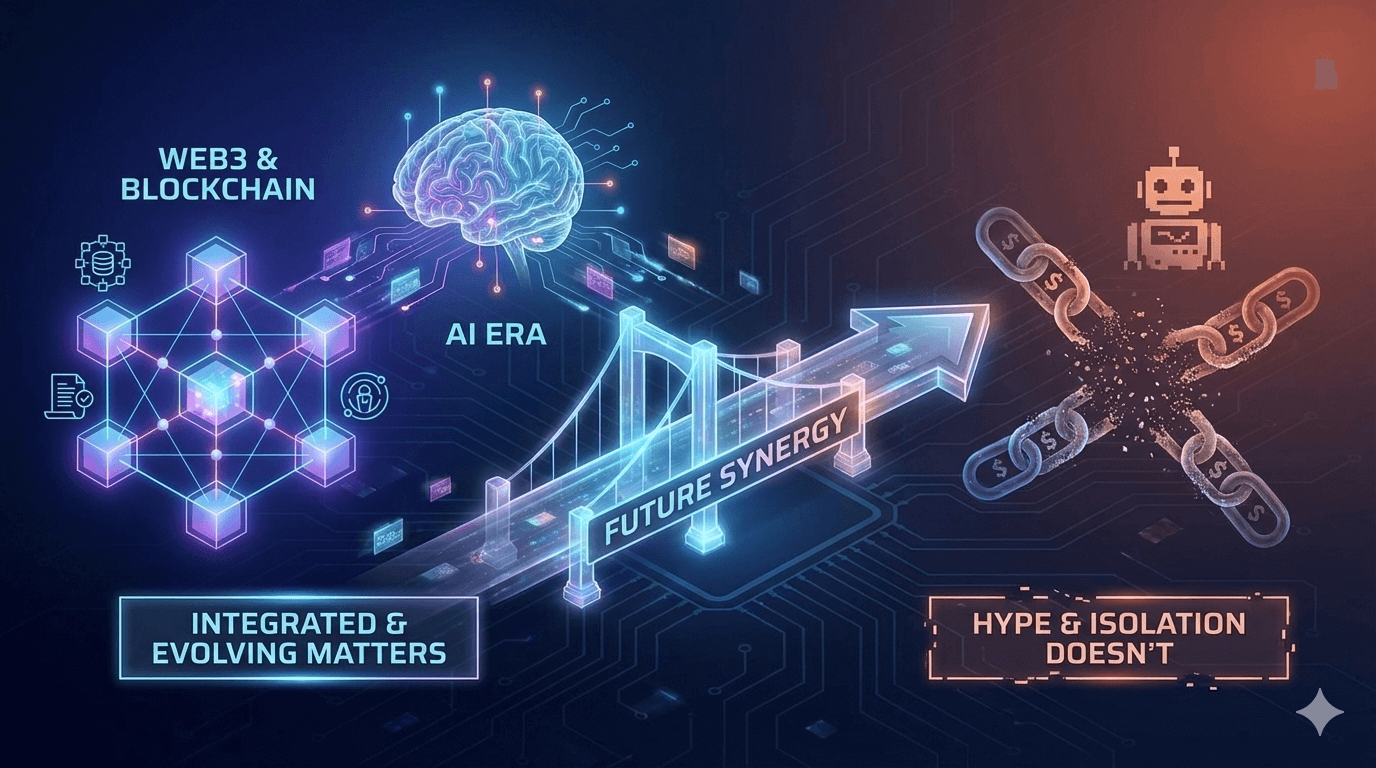
The AI era is accelerating how we build products: agents browse, generate, and act; content volume explodes; and trust becomes harder to establish. In that context, it’s fair to ask: does Web3/blockchain still matter—or did AI make it irrelevant?
My take: blockchains are still valuable, but only when you need a shared, tamper-resistant ledger across parties that don’t fully trust each other. AI doesn’t replace that. It does, however, raise the bar for what’s worth decentralizing.
What blockchain is good at (in plain terms)
Blockchains are not “faster databases.” They are:
- Coordination machines: shared rules for multiple parties.
- Audit logs: append-only history that’s hard to rewrite.
- Permissionless infrastructure: anyone can verify state, not just one company.
If your problem is “store data and query it efficiently,” use a normal database. If your problem is “multiple actors need a shared source of truth without a central owner,” blockchain can fit.
Why AI changes the conversation
AI introduces new problems that look like blockchain-shaped nails:
- Synthetic content everywhere: who created this, when, and how can we verify it?
- Agent-to-agent interactions: autonomous software negotiating, paying, or requesting access.
- Data licensing + attribution: tracking usage of datasets, prompts, or generated assets.
- Model and tool supply chains: which model version produced which output, under which policy?
But AI also makes “blockchain for everything” less attractive: latency, UX, cost, and governance complexity hurt more when users expect instant, fluid experiences.
High-signal Web3 use cases in the AI era
1) Provenance and verifiable audit trails
If you need to prove that a piece of content (or a decision) happened at a certain time and hasn’t been altered, an on-chain or anchored record can help.
Examples:
- Publishing hashes of important documents (contracts, certificates, official statements).
- Tracking model versions used for critical outputs (compliance workflows).
- Attesting that a dataset snapshot existed before training began.
The key pattern is store the proof, not the payload:
- Put the hash/attestation on-chain.
- Keep the large content off-chain (object storage, databases, IPFS, etc.).
2) Decentralized identity (DID) and credentials
AI agents will increasingly act on behalf of people and organizations. Identity primitives become important:
- Who is this agent?
- What is it allowed to do?
- Can it present verifiable credentials?
DIDs and verifiable credentials can provide portable, privacy-aware identity constructs—useful for cross-platform access without relying on a single vendor.
Reality check: centralized identity (OAuth/OIDC) remains dominant for mainstream apps. Web3 identity tends to shine in multi-org ecosystems.
3) Payments and “agent commerce”
Agents that take actions (call APIs, purchase, reserve, subscribe) create a need for:
- micropayments
- escrow
- programmable payouts (rev-share, royalties)
Blockchain rails can enable global payments without building partnerships in every region. This is more compelling when the product is inherently borderless (developer tools, APIs, marketplaces).
4) Incentives and coordination (when you truly need it)
Tokens are often misused as “growth hacks,” but incentives do have legitimate roles:
- bootstrapping a two-sided marketplace
- rewarding valuable contributions (labels, moderation, compute, data)
- funding public goods (open-source tooling, standards, infra)
In AI, this could show up in:
- dataset labeling networks
- decentralized evaluation/benchmarking marketplaces
- compute-sharing markets (with lots of caveats)
If incentives don’t match real value, the system becomes fragile (sybil attacks, spam, mercenary behavior).
Where Web3 is usually the wrong choice
1) Standard web apps and CRUD dashboards
If there’s one product owner and one database, decentralization adds cost without adding trust. Most portfolios, SaaS dashboards, and CMS products fit this category.
2) High-performance, low-latency experiences
Blockchain reads/writes are rarely suited for:
- rapid UI updates
- realtime interactions
- heavy analytics
You can integrate blockchain at the edges (identity, payment, proof), while keeping the UX fast with conventional architecture.
3) “Decentralized storage” as a default
Storing everything on-chain is expensive; storing everything on IPFS is not automatically better than S3/R2. You still need:
- pinning strategy
- availability guarantees
- access control
- abuse controls
A pragmatic architecture that combines AI + Web3
If you’re building a real product, aim for a hybrid:
- Core product: normal database + API (fast, ergonomic, debuggable).
- AI layer: model calls, tool orchestration, logging, evaluation.
- Web3 edge (optional):
- identity proofs (DID/VC)
- payment rails
- provenance attestations (hash anchoring)
This keeps your system maintainable while allowing you to use blockchain where it provides unique value.
Risks and tradeoffs (don’t ignore these)
- UX complexity: wallets, key management, confirmations.
- Regulatory uncertainty: varies wildly by country and product type.
- Security surface area: smart contracts are hard to patch; audits matter.
- Governance: decentralization is a social problem as much as a technical one.
- Cost + volatility: fees and asset prices can make budgeting difficult.
The AI era increases the stakes: automated actors can amplify exploits, spam, and manipulation. If you add incentives, you must add robust abuse resistance.
So… does Web3 matter in 2026?
Yes—but the winning stories are narrower and more grounded:
- Proof and provenance
- Identity and credentials
- Payments for agent-driven software
- Coordination where no single party should own the system
If you’re evaluating Web3 for an AI product, the best question is:
“What trust problem exists here that we cannot solve with a conventional system and contracts?”
If you can answer that clearly, blockchain might help. If not, focus on shipping a great product first—then add Web3 where it truly earns its complexity.