A micro-frontend architecture breaks a single frontend application into multiple independently developed and deployed pieces. Each piece (often owned by a team) can be built, released, and versioned separately—while still composing into one user experience.
The goal isn’t “more frameworks.” The goal is organizational scalability: enabling multiple teams to move fast without stepping on each other.
The core idea
Instead of one monolithic frontend repo/app, you have:
- multiple “vertical slices” (e.g., Billing, Search, Admin, Account)
- each slice can ship independently
- a shell/app host composes them into one product
This mirrors microservices on the backend, but for UI.
Common micro-frontend patterns
1) Build-time composition (recommended first)
Multiple packages are built together into one deployable artifact.
- Pros: simpler runtime, one app, fewer edge cases
- Cons: not fully independent deployments
This looks like a monorepo with packages and shared design system components.
2) Runtime composition (true independent deployments)
The host loads remote bundles at runtime (e.g., Module Federation, remote entries).
- Pros: each team can deploy without coordinating releases
- Cons: complexity: caching, versioning, shared deps, performance, debugging
3) “Islands” / widget embedding
Embed independently shipped widgets into a page (think: “drop-in” apps).
- Pros: great for incremental adoption
- Cons: can fragment UX if not governed by a design system
4) iFrames (the blunt instrument)
Still used in enterprise environments because of isolation.
- Pros: strong isolation and security boundaries
- Cons: UX limitations, routing/state integration is painful
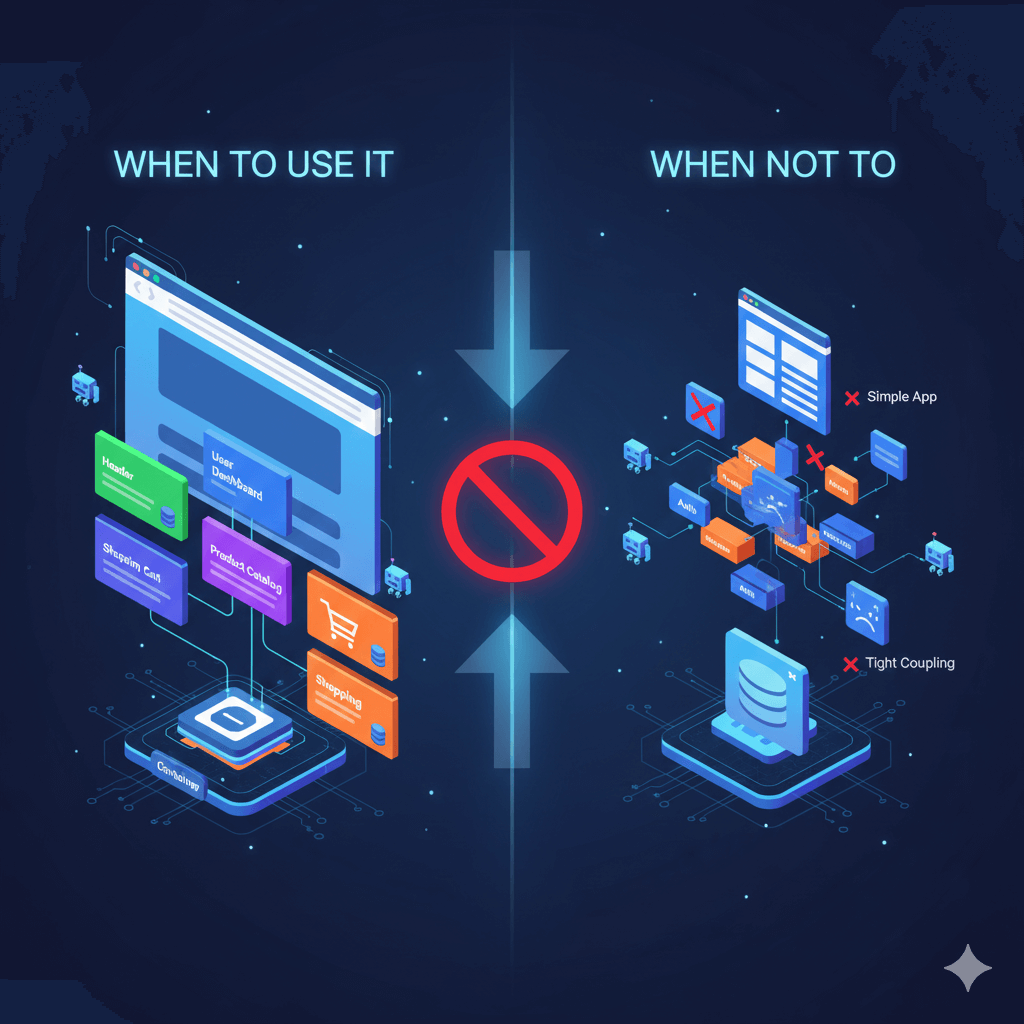
When micro-frontends make sense
Micro-frontends are worth considering when:
- you have multiple teams working on one product (usually 3+ teams)
- releases are blocked by a shared deployment pipeline
- ownership boundaries are clear and stable (Billing ≠ Search ≠ Admin)
- you need team autonomy more than you need simplicity
If your main pain is “our repo is messy,” micro-frontends usually aren’t the solution. Fix architecture, boundaries, and tooling first.
When you should avoid micro-frontends
Avoid (or delay) micro-frontends if:
- you’re a small team (1–2 squads)
- you need a unified UX but don’t have a strong design system
- performance budgets are tight and you can’t afford duplicate JS/CSS
- your product changes quickly and boundaries shift every month
Micro-frontends can accidentally create:
- duplicated dependencies (React twice, UI libs multiple times)
- inconsistent UX patterns
- slower pages due to more runtime loading and coordination
The hidden hard parts (plan for these)
Micro-frontends succeed when the organization commits to governance:
- Design system: shared components, tokens, and accessibility rules
- Routing: consistent navigation, deep linking, and back/forward behavior
- Auth/session: shared identity and consistent permissions
- Observability: shared logging, error reporting, performance metrics
- Versioning: contracts between host and remotes
- Performance: shared deps strategy, code splitting, caching policies
Without these, micro-frontends become “multiple apps glued together.”
Practical recommendation
If you’re curious about micro-frontends, start with the least risky approach:
- Build a modular monolith frontend (clear packages, boundaries, ownership).
- Introduce a shared UI system and enforce it.
- Only move to runtime micro-frontends when independent deployments become a real bottleneck.
Micro-frontends are not a silver bullet—but in the right org, they can be a powerful way to scale frontend delivery without sacrificing velocity.