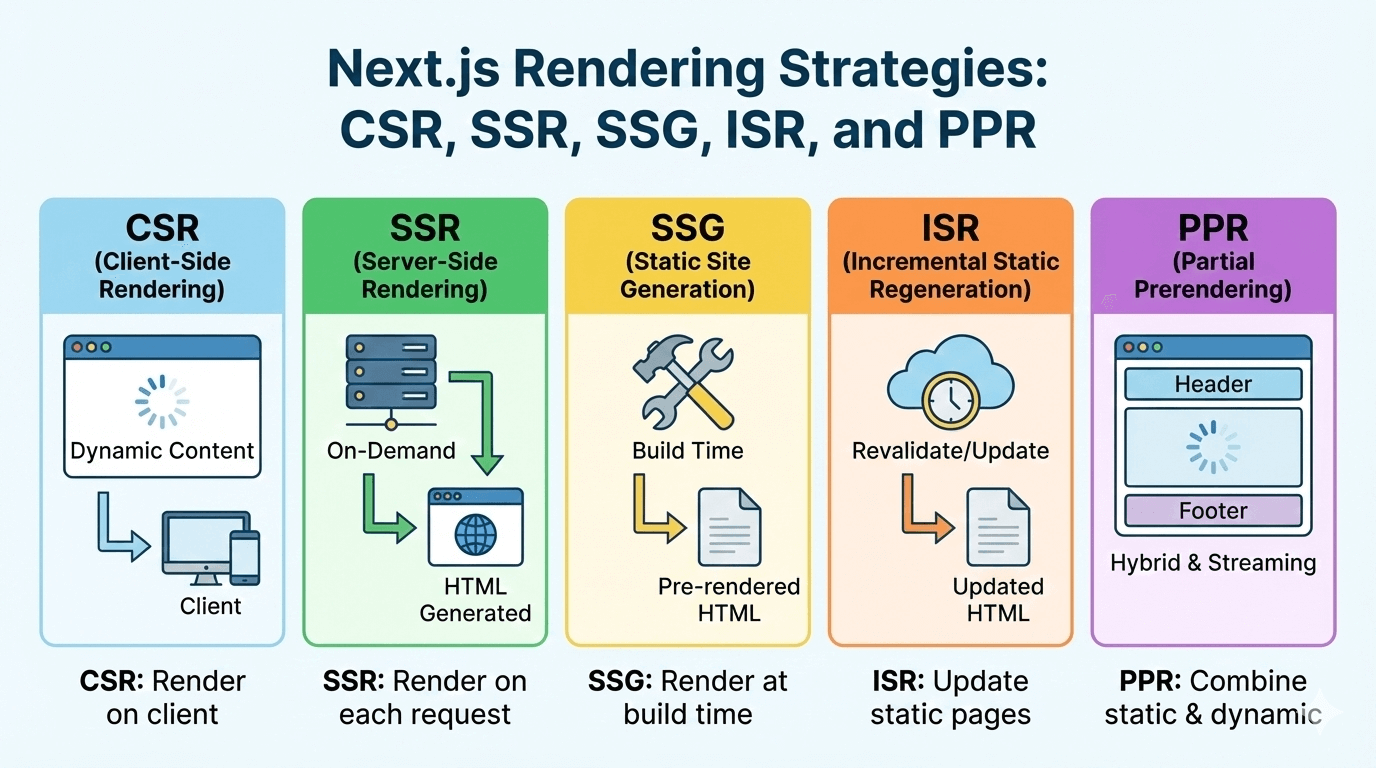
Next.js gives you multiple rendering strategies. They’re not “either/or” choices—you can mix them per route, per layout, and even per component. The best approach depends on data freshness, SEO, and time-to-first-byte.
CSR (Client-Side Rendering)
CSR renders the page in the browser. The server sends a minimal HTML shell, then React fetches data and builds the UI on the client.
- Use when: highly interactive UI, data is user-specific, SEO is not critical.
- Tradeoffs: slower first content for users, depends on JS, can be harder for SEO if content arrives late.
In the App Router, CSR usually means a "use client" component that fetches data in the browser.
SSR (Server-Side Rendering)
SSR renders HTML on the server for each request. Users get content immediately, and the client hydrates for interactivity.
- Use when: content must be fresh per request, personalization, auth-gated pages.
- Tradeoffs: higher server cost, slower than cached static HTML.
In App Router, SSR happens naturally when a Server Component fetches uncached data or the route is marked dynamic.
SSG (Static Site Generation)
SSG pre-renders pages at build time. The output is static HTML that can be served from a CDN.
- Use when: content changes rarely, docs/marketing pages, predictable routes.
- Tradeoffs: content is as fresh as your last build.
In App Router, SSG typically uses generateStaticParams() with cached data (or no data at all).
ISR (Incremental Static Regeneration)
ISR is “SSG + revalidation”. Pages are served statically, but Next.js can regenerate them after a time window (or on-demand), so you get CDN performance with controlled freshness.
- Use when: content updates regularly but not every request (blogs, product pages).
- Tradeoffs: users may see slightly stale content until revalidation runs.
Example pattern:
export const revalidate = 60; // regenerate at most once per minuteThis repo uses that pattern on blog detail pages to balance freshness and speed.
PPR (Partial Pre-Rendering)
PPR (Partial Pre-Rendering) combines a static shell with dynamic streaming so users get a fast initial render, while personalized or frequently-changing parts stream in later.
- Use when: most of the page is cacheable, but some parts must be dynamic (auth widgets, dashboards, “live” sections).
- Tradeoffs: more complexity; feature availability/flags may change across Next.js versions.
PPR is conceptually similar to “static layout + dynamic islands”, but integrated into Next.js routing and streaming.
How to choose (quick rules)
- Need SEO + fast load: prefer SSG/ISR.
- Need per-request freshness or auth: use SSR.
- Need heavy interactivity and user-specific use CSR for that part (not necessarily the whole page).
- Mostly static but a few dynamic bits: consider PPR/streaming and keep the dynamic parts isolated.
How this site maps to these strategies
- Blog pages: ISR (cached + revalidate) for good SEO and speed.
- Admin: SSR/dynamic (auth-gated, always up-to-date).
- Developer tools: mostly static UI with client-side interactivity (CSR inside Client Components).
The key is to choose the rendering strategy based on the user experience you want: first paint speed, SEO, and freshness.